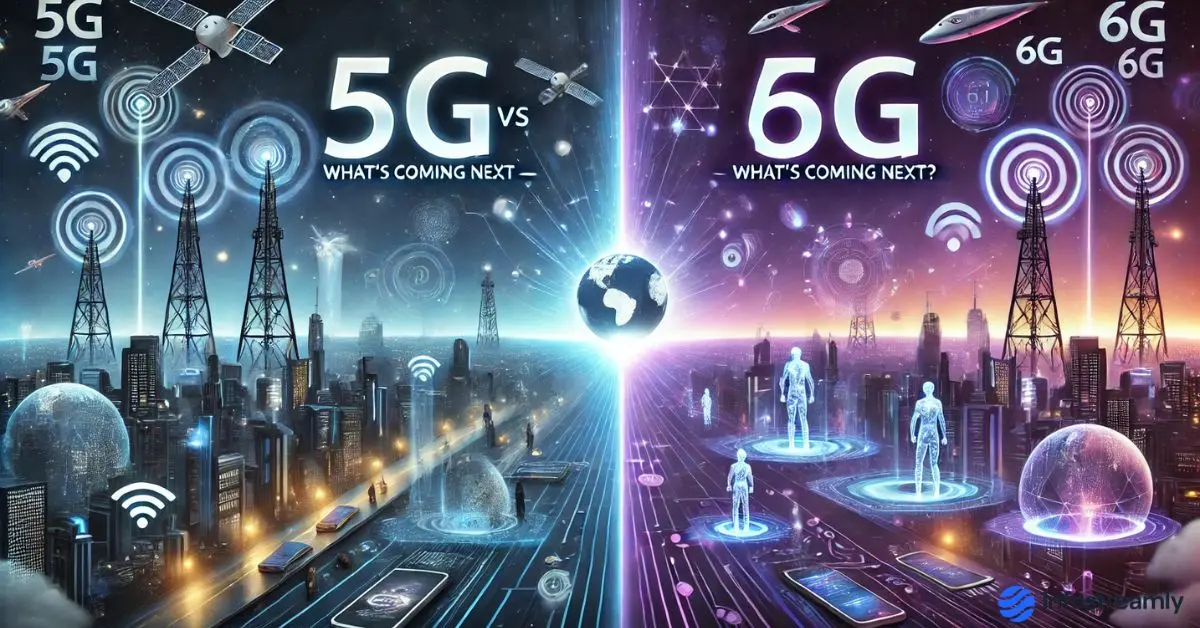
You know what’s funny? Most of us just started enjoying everything 5G offers—the crazy-fast downloads, the no-buffering YouTube, and that smooth browsing we waited years for. But the moment people began settling into it, the whole tech world shifted the spotlight to 5G vs 6G Explained, hinting that an even bigger upgrade is already on the way.
Still sounds wild, right? Like, do we really need another generation so soon? But apparently, 6G isn’t just about faster speed—it’s about turning the entire internet into something much smarter, quicker, and more connected.
So let’s break it down in the simplest way possible—what’s coming next, how 6G is different, and why everyone is comparing 5G vs 6G as the next giant leap in wireless technology.
What Exactly Is 5G?
Think of 5G as the technology that made everything around us “smarter.” It didn’t just speed up our internet—it allowed devices to talk to each other instantly.
With 5G, your phone, car, smartwatch, and even your fridge can stay connected at once. It made real-time communication possible, whether for gaming, streaming, or controlling smart devices.
Main Highlights of 5G
- Speed: Up to 10 Gbps (around 100x faster than 4G)
- Latency: Just 1 millisecond delay—almost instant
- Capacity: Can handle about 1 million devices per square kilometer
- Use Cases: Smart cities, self-driving cars, VR/AR, remote surgeries
For a deeper technical explanation, check Qualcomm’s official 5G overview:
https://www.qualcomm.com/5g
In short, 5G made our lives more connected and more digital.
What Is 6G—and Why Is Everyone Talking About It?
6G is the next evolution—expected to launch commercially around 2030. But it’s not just a faster network.
It’s about intelligence—networks that can think, adapt, and even heal themselves using built-in AI.
Imagine living in a world where you can make holographic calls, download full movies in seconds, and interact with digital twins of real objects.
That’s what 6G promises.
What Is 6G—and Why Is Everyone Talking About It?
6G is the next evolution—expected to launch commercially around 2030. But it’s not just a faster network.
It’s about intelligence—networks that can think, adapt, and even heal themselves using built-in AI.
Imagine living in a world where you can make holographic calls, download full movies in seconds, and interact with digital twins of real objects. That’s what 6G promises.
Expected Features of 6G
- Speed: Up to 1 terabit per second (yes, that’s 100x faster than 5G!)
- Latency: Below 0.1 milliseconds
- AI-Powered: Network runs on artificial intelligence
- Spectrum: Uses ultra-high Terahertz (THz) frequencies
- Use Cases: Holograms, brain-computer links, digital twins, space internet
👉 For early research insights, see Nokia & EU’s Hexa-X 6G project:
https://www.nokia.com/networks/6g/hexa-x
6G isn’t just about connecting devices—it’s about connecting intelligence.
5G vs 6G: Simple Comparison
| Feature | 5G | 6G |
| Launch Period | 2019–2020 | Around 2030 |
| Top Speed | 10 Gbps | 1 Tbps |
| Latency | 1 ms | 0.1 ms |
| Spectrum | Sub-6 GHz & mmWave | Terahertz (THz) band |
| AI Integration | External | Built-in AI |
| Connectivity | People & devices | People, devices & intelligence |
| Applications | IoT, AR/VR, automation | Holograms, digital twins, brain links |
| Coverage | Ground-based towers | Global + satellite network |
6G Won’t Just Be Faster—It’ll Be Smarter
The jump from 5G to 6G isn’t just about raw power.
6G will bring a new kind of intelligence. It won’t wait for human input—it’ll predict what you need before you even ask.
For example:
- Your car will talk to nearby vehicles to prevent accidents.
- Hospitals will use robotic surgeons performing operations remotely with zero delay.
- Factories will create “digital ”twins”—virtual copies to predict failures and save time.
Basically, 6G will erase the line between the real and digital worlds.
Who’s Leading the 6G Race?
Every major tech nation is already running in the 6G marathon.
- South Korea & Japan—Testing early 6G networks in labs.
- China launched the first experimental 6G satellite in orbit.
- USA & Europe—Funding huge projects like Next G Alliance and Hexa-X.
- India—Pushing ahead with Bharat 6G Vision 2030 to build homegrown technology.
This isn’t just a race for faster internet. It’s a race for global digital leadership—whoever wins 6G could shape the future of data, economy, and AI.
6G + AI = The Ultimate Combo
Here’s where things get interesting.
6G will be the first AI-native network—meaning, it won’t just use AI; it will run on AI.
AI will:
- Manage data automatically
- Predict traffic congestion
- Fix issues before users even notice them
- Optimize energy use across the entire network
It’s like giving your internet a brain.
Challenges Before 6G Becomes Reality
Of course, it’s not all easy.
Before we see 6G everywhere, the world needs to solve a few tough problems:
- Hardware limits: Terahertz frequencies need advanced antennas and cooling systems.
- Energy cost: Faster speed means more power consumption—sustainability is key.
- Security risks: With AI controlling networks, privacy and safety will become even more critical.
- Standardization: Countries and telecom giants must agree on global 6G rules and frequency bands.
The road to 6G will take years—but the destination will be worth it.
Real-World Use Cases of 6G
- Holographic Calls: Talk to a 3D version of someone—like a real-life video hologram.
- Digital Twins: Simulate entire factories or cities in real time to predict problems.
- Brain-Computer Links: Communicate or control devices with your thoughts.
- Space Connectivity: Internet beamed directly from satellites to your device.
- Metaverse 2.0: Fully immersive worlds with real-time sensory interaction.
These are not science fiction anymore—researchers are already building early versions of each.
Why This Transition Matters
5G made it possible to connect billions of devices.
6G will connect everything, including intelligent systems that think on their own.
It will impact:
- Healthcare: Real-time remote treatments.
- Education: Virtual classrooms with holographic teachers.
- Transport: Smart cars and AI-managed traffic.
- Industry: Zero-delay robotics and automation.
Early adopters—countries, companies, and creators—will have a massive advantage once 6G becomes mainstream.
Conclusion
So, what’s the big picture?
5G is today’s innovation, but 6G is tomorrow’s revolution.
While 5G focuses on speed and connectivity, 6G will add intelligence, sensing, and emotion to communication.
By 2030, it won’t just be about fast downloads—it’ll be about real-time experiences that feel almost human.
The journey from 5G to 6G shows one truth:
we’re moving from a connected world to an intelligent universe.
Final Verdict
In short, 5G vs 6G isn’t just about speed—it’s about evolution.
5G built a smart world.
6G will build an intelligent one.
It will connect not only devices but also ideas, emotions, and data — all in real time.
And when it arrives, our phones, homes, cars, and even our cities will be smarter than ever.
Key Takeaways
- 5G is fast—but 6G will be 100× faster.
- 6G will use terahertz bands and integrate AI at its core.
- Expect new tech like holograms, digital twins, and space internet.
- Major countries are already investing heavily in research.
- Launch is expected by 2030, changing how humans and machines connect.
If you enjoyed this post, follow InfoStreamly for more updates on the future of technology, AI, and digital innovation. The next era of wireless is coming—and you’ll want to be ready when it does.
FAQs
- When will 6G be available to the public?
Early commercial 6G networks may appear around 2030, with testing starting before 2028. - How much faster is 6G than 5G?
6G could be up to 100 times faster, offering 1 terabit per second speeds. - Can 6G work with existing devices?
No. Just like 4G phones couldn’t use 5G, we’ll need new devices for 6G. - Which country is leading 6G research?
China, South Korea, Japan, and the United States are leading the global 6G race. - What new experiences will 6G enable?
6G will make holographic communication, immersive metaverse, and brain-computer interfaces possible.

Chandra Mohan Ikkurthi is a tech enthusiast, digital media creator, and founder of InfoStreamly — a platform that simplifies complex topics in technology, business, AI, and innovation. With a passion for sharing knowledge in clear and simple words, he helps readers stay updated with the latest trends shaping our digital world.