2025 has just begun, and honestly, the internet doesn’t feel as calm as it used to. Cybersecurity threats 2025 are growing faster, getting smarter, and becoming a lot more unpredictable.
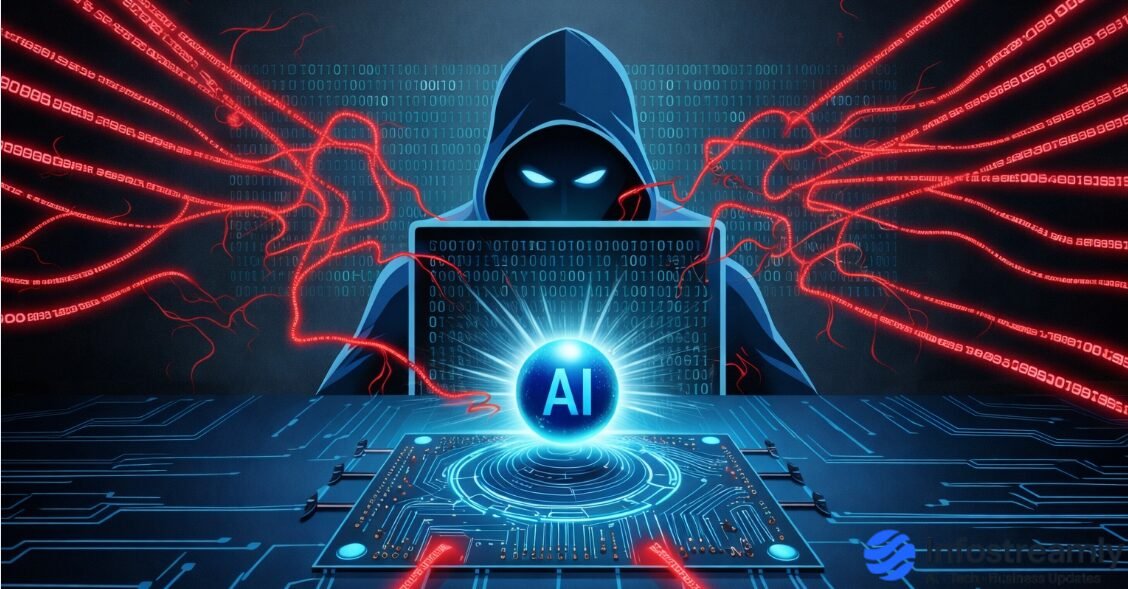
Hackers these days aren’t the movie-style loners sitting in dark rooms. They’ve got AI tools, deepfake tricks, and even quantum-style hacks helping them slip past security like pros.
Every time we click a link, open an email, or log in somewhere, it feels like we’re taking a small risk.
From global companies to small startups—and even regular folks using phones at home—no one’s completely safe anymore.
So, let’s break it down and look at the Top 10 Cybersecurity Threats 2025 and see how these silent dangers are changing the way we stay safe online.
1. AI-Driven Cyber Attacks
AI-driven cyber attacks are growing much faster than traditional threats, and the impact is visible across every industry. Recent research from the IBM X-Force Threat Intelligence Index shows that attackers are now using automation and advanced analytics to discover vulnerabilities within minutes. This means organizations have a much smaller window to react before an attack spreads. With AI tools helping hackers customize phishing messages, write malicious code, and bypass security filters, businesses need stronger defense systems and real-time monitoring to stay ahead.
Example: Some hackers now use AI chatbots to fool employees into sharing passwords.
Impact: More personalized phishing attacks and faster data theft.
Tip: Use AI-based security systems that can spot strange activity instantly.
2. Ransomware 3.0
Ransomware 3.0 is becoming more aggressive in 2025, and many companies are struggling to keep up with the speed of new attacks. Recent findings from the Kaspersky Threat Intelligence Reports show that modern ransomware groups now use multi-layered extortion methods—stealing data, threatening leaks, and targeting business partners at the same time. These reports also highlight how attackers are shifting toward cloud storage, IoT devices, and remote-access vulnerabilities to gain quick entry into systems. This makes regular backups, stronger endpoint protection, and employee awareness more important than ever.
Trend: Hackers now attack not just one victim but also the victim’s customers and partners.
Impact: Huge financial loss and damaged reputation.
Example: Schools and hospitals are common targets because they use old, outdated systems.
Solution: Always back up your data, use antivirus tools, and train your staff to spot suspicious files.
If you want to protect your device from common threats like ransomware, malware, and phishing files, don’t forget to check our detailed guide on the Best Free Antivirus Tools 2025 – Top 10 Free Security Software for Your PC.
3. Deepfake-Based Scams
Deepfake-based scams are becoming a serious global issue in 2025. Fake videos and AI-generated voices are now so realistic that even trained professionals struggle to tell them apart. According to the Europol Cybercrime Centre, these deepfake attacks are rising sharply across Europe and Asia, especially in financial fraud and identity theft cases. Hackers are using this technology to impersonate CEOs, government officials, and even family members to trick victims into sending money or sharing sensitive information. This is why companies are being urged to verify all high-value transactions through multi-step authentication.
Example: A hacker creates a fake video of a company CEO “approving” a money transfer. The company loses millions before realizing it was fake.
Impact: Identity theft, financial loss, and fake news spreading fast.
Action: Use deepfake detection software and always confirm important messages by phone or video call.
4. Quantum Decryption Threat
Quantum computers are amazing—they can solve problems in seconds that normal computers take years for.
But here’s the scary part: they might also break the encryption that keeps our data safe.
Risk: Older encryption methods like RSA could be cracked open.
Impact: Government secrets and corporate data could be exposed.
Solution: Switch to post-quantum encryption—it’s designed to resist these super-powerful attacks.
5. Cloud Data Breaches
Almost every company now stores data in the cloud. It’s convenient—until someone misconfigures a setting.
That small mistake can expose millions of records online.
Example: Public cloud folders left open have leaked customer data countless times.
Impact: Loss of privacy, heavy fines, and broken trust.
Fix: Use Zero Trust security, encrypt everything, and check your access settings regularly.
6. IoT Device Exploitation
We all love smart gadgets—from fitness bands to smart home cameras. But each device is also a tiny computer connected to the internet… and hackers love that.
Example: A hacker takes control of your smart camera and uses it to enter your home Wi-Fi network.
Impact: They can spy on, steal from, or even control other devices.
Tip: Keep your devices updated, and don’t connect everything to the same Wi-Fi network.
7. Supply Chain Attacks
Even if your company’s security is strong, your suppliers might not be.
Hackers now target small vendors to get into bigger systems through them—a silent and smart move.
Example: A trusted software update hides malicious code that spreads to thousands of users.
Impact: Major data leaks and operational shutdowns.
Solution: Always verify software updates and audit your vendors’ security.
8. Social Engineering 2.0
Phishing emails are getting smarter—and creepier.
Thanks to AI, hackers now create personalized messages that feel real.
Example: You get a LinkedIn message about a “job offer,” but it’s actually a malware link.
Impact: Stolen credentials, hacked accounts, and company breaches.
Fix: Double-check sender details and never download unexpected attachments.
9. Critical Infrastructure Attacks
Critical infrastructure attacks are becoming one of the biggest concerns in Cybersecurity Threats 2025. Power grids, water systems, transport networks, and communication lines are now common targets for advanced cybercriminals and nation-state hackers. According to the Cybersecurity & Infrastructure Security Agency (CISA), these systems are under increasing risk because many of them still run on outdated technology and lack real-time monitoring. Even a single breach can cause blackouts, water contamination, or major public disruptions. This is why governments and companies are being advised to strengthen monitoring systems and follow updated CISA cybersecurity guidelines to stay prepared.
Example: A remote exploit that shuts down a city’s water system.
Impact: Public safety risks and economic disruption.
Solution: Governments and companies must secure vital systems and monitor them 24/7.
10. Insider Threats
Sometimes, the biggest threat comes from inside.
An unhappy employee or careless worker can leak or delete sensitive data—sometimes without even realizing it.
Example: Someone uploads company files to personal cloud storage “to work from home.”
Impact: Intellectual property loss or data exposure.
Fix: Limit who can access what, and use tools that track unusual employee activity.
Conclusion
When you look at everything happening around us, it’s a bit clear what’s going on.
Cybersecurity threats 2025 are no longer some “tech department” issue. They touch everyone now… you, me, businesses, even people who barely use the internet.
AI and automation help us in many good ways, but they also give hackers a bigger toolbox. That’s the tough part.
The only thing we can really do is stay a little more careful. Update things when needed, don’t ignore warnings, and just be more aware of what we click or open.
Simple habits make a big difference—changing passwords once in a while, double-checking strange links, and slowing down when something feels odd.
At the end of the day, technology can protect us only to a point. The rest depends on how alert we are and how seriously we take our own online safety.
Final Verdict
At the end of the day, one thing is clear: Cybersecurity threats 2025 are only going to get sharper, smarter, and harder to stop. The tools hackers use are evolving fast, and sometimes it feels like we’re trying to keep up with a moving target.
But staying safe doesn’t require fear—it just needs awareness. A few simple habits, like checking links before clicking, updating your devices, and using stronger passwords, can protect you more than you think.
Technology will keep improving, and so will the attacks. What really matters is how prepared we are. If we stay alert and take online safety seriously, we can handle most of these threats before they reach us.
In the end, cybersecurity isn’t just about systems and software—it’s about people staying smart, careful, and one step ahead.
Key Takeaways
- AI will power both attackers and defenders in 2025.
- Ransomware 3.0 and deepfakes will become major threats.
- Quantum computers could break today’s encryption.
- Cloud and IoT devices are easy targets if not secured.
- Human awareness is still the best defense against cybercrime.
👉 If you run a business, this is the year to upgrade your security game.
Do a full audit, train your employees, and move toward Zero Trust security.
If you’re an individual, update your passwords, enable two-factor authentication, and stop clicking every link that pops up.
Because in 2025, cybersecurity isn’t just a tech issue.
It’s personal safety—for you, your data, and your digital life.
FAQs
- What is the biggest cybersecurity threat in 2025?
AI-driven attacks and deepfake scams are the fastest-growing threats this year. - How can small businesses protect themselves?
Start with simple steps: update software, back up data, and train your team to spot suspicious activity. - Are individuals really at risk?
Yes! Anyone with a phone, laptop, or smart device is a potential target. - What is “Zero Trust” security?
It means never automatically trusting anyone—whether inside or outside your network—without verifying their identity. - How do I detect a deepfake?
Watch for unnatural eye movements, lighting mismatches, or delayed lip sync. When in doubt, confirm the source through another channel.

Chandra Mohan Ikkurthi is a tech enthusiast, digital media creator, and founder of InfoStreamly — a platform that simplifies complex topics in technology, business, AI, and innovation. With a passion for sharing knowledge in clear and simple words, he helps readers stay updated with the latest trends shaping our digital world.