If you’re wondering “What is RBI’s Digital Rupee? Explained Simply” — you’re not alone. Ever since the Reserve Bank of India (RBI) introduced the Digital Rupee (e₹) as India’s official digital currency, many people have been confused about how it works, how it differs from UPI, and whether it is safe to use.
The good news?
It’s actually far simpler than it sounds. RBI’s Digital Rupee is just a digital version of cash, created and guaranteed by the Government of India—not a cryptocurrency, not UPI, and not a bank deposit.
This guide breaks down the concept in the simplest way possible so that students, employees, investors, and everyday users can clearly understand India’s digital currency future.
What is RBI’s Digital Rupee? Explained Simply
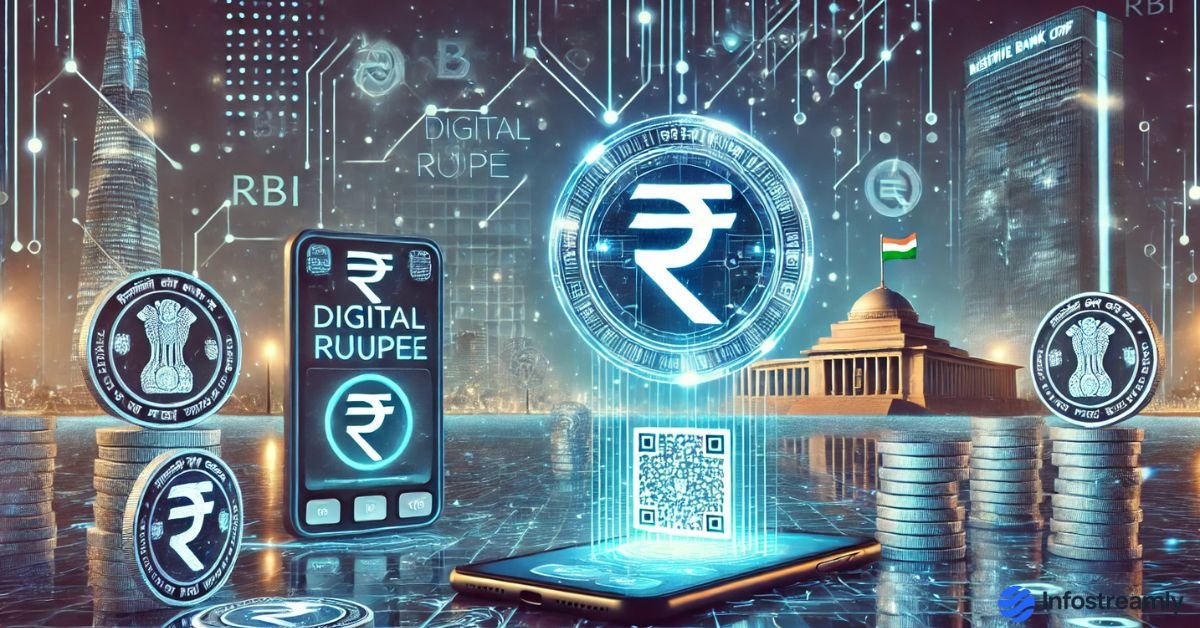
The Digital Rupee (also called e₹ or CBDC) is India’s official digital form of money issued directly by the Reserve Bank of India, just like physical notes and coins.
Think of it like this:
- Cash in your pocket = Physical Rupee
- Cash on your phone = Digital Rupee (e₹)
It looks like a mobile wallet, but instead of storing UPI balance or bank balance, you store actual RBI digital money.
✔ Key Points
- It is legal currency issued by RBI.\
- It can be used for shopping, payments, sending/receiving money.
- You can store it in a Digital Rupee Wallet.
- It works even without a bank transaction, like physical cash.
- It is not a cryptocurrency and has no price fluctuation.
- Its value is the same as ₹1 physical rupee.
Why Was It Introduced?
RBI launched e₹ to:
- Make payments faster
- Reduce printing costs of cash
- Improve transparency
- Strengthen digital India
- Allow offline digital payments in the future
India is one of the few countries to officially test and launch such a digital currency at scale.
Types of Digital Rupee (e₹)
1. e₹-Retail (CBDC-R)
For public use—students, shopkeepers, employees, households.
You can use it like UPI, but the balance comes from RBI directly.
2. e₹-Wholesale (CBDC-W)
For banks and financial institutions — not for public use.
How Does the Digital Rupee Work?
Just install the RBI Digital Rupee Wallet App provided by your bank (SBI, HDFC, ICICI, Yes Bank, etc.).
You can:
✔ Load money from your bank
✔ Send/receive e₹ instantly
✔ Pay QR codes like UPI
✔ Store it offline (future feature)
But here’s the difference:
When you load money into the wallet, your bank deducts it and converts it into Digital Rupee directly issued by RBI.
Digital Rupee vs UPI vs Cryptocurrency
| Feature | Digital Rupee (e₹) | UPI | Cryptocurrency |
| Issued By | RBI | Bank account | Private company |
| Value Stability | Stable | Stable | Highly volatile |
| Legal Status | Legal tender | Payment method | Not legal tender |
| Works Offline? | Coming soon | No | Yes (for some) |
| Backed By Govt? | Yes | Indirectly | No |
Conclusion
Digital Rupee is safer than crypto and more advanced than UPI.
Is RBI’s Digital Rupee Safe?
Yes—100% safe.
Because:
- It is issued by RBI
- Stored in secure wallet apps
- Works on a controlled blockchain-like system
- Has full government backing
Your money is as safe as keeping cash, maybe even safer.
Benefits of Digital Rupee (e₹)
✔ No need for a bank transfer
Money goes from one wallet to another instantly.
✔ Zero transaction charges
RBI has made e₹ completely free to use.
✔ Faster payments than UPI
UPI depends on banks.
Digital Rupee is direct RBI money, so it is faster.
✔ Useful in remote areas
Offline digital rupee will help rural India.
✔ Transparent & secure
Reduces fake notes and black money risk.
Also Read: Top Digital Payment Trends in India 2025 (Updated Future Guide)
Real-Life Uses of Digital Rupee
- Buying groceries
- Shopping online
- Paying bills
- Sending money instantly
- Business transactions
- Government benefits
- Tourism & cross-border payments (future)
How to Get RBI’s Digital Rupee Wallet
Available through selected banks:
- State Bank of India
- ICICI Bank
- HDFC Bank
- Yes Bank
- Bank of Baroda
- Kotak Mahindra Bank
Step-by-step:
- Download the Digital Rupee Wallet App from your bank
- Complete KYC
- Add money from bank → Convert to e₹
- Start paying instantly
Conclusion
Understanding “What is RBI’s Digital Rupee Explained Simply” becomes easy once you see it as digital cash created by RBI. It’s not crypto, not UPI — it’s a new digital form of India’s official currency designed for the future of payments.
Final Verdict
If you’re still thinking “What is RBI’s Digital Rupee Explained Simply?” — the answer is straightforward:
It’s India’s next-generation money, fully safe, government-backed, and built for a faster digital economy.
Key Takeaways
- The Digital Rupee is RBI’s official digital money.
- Works like digital cash, not like crypto.
- Faster and cheaper than UPI.
- Fully safe and government-backed.
- Perfect for future online and offline payments.
Call to Action
If you found this guide helpful and now understand “What is RBI’s Digital Rupee Explained Simply,” explore more finance and technology topics on our website for smart and simple explanations.
FAQs
1. What is RBI’s Digital Rupee Explained Simply in one line?
It is a digital form of Indian currency issued by RBI, just like physical cash but stored on your phone.
2. Is Digital Rupee the same as UPI?
No. UPI is a payment system; Digital Rupee is actual RBI-issued money.
3. Is Digital Rupee safe?
Yes, it is fully backed and regulated by the Reserve Bank of India.
4. Is Digital Rupee a cryptocurrency?
No. It has fixed value and is controlled by RBI, unlike crypto.
5. Can I use the Digital Rupee without internet?
RBI plans to launch offline e₹ payments soon.
6. Where can I get the Digital Rupee wallet?
Through supported banks such as SBI, ICICI, HDFC, Yes Bank, etc.

Chandra Mohan Ikkurthi is a tech enthusiast, digital media creator, and founder of InfoStreamly — a platform that simplifies complex topics in technology, business, AI, and innovation. With a passion for sharing knowledge in clear and simple words, he helps readers stay updated with the latest trends shaping our digital world.