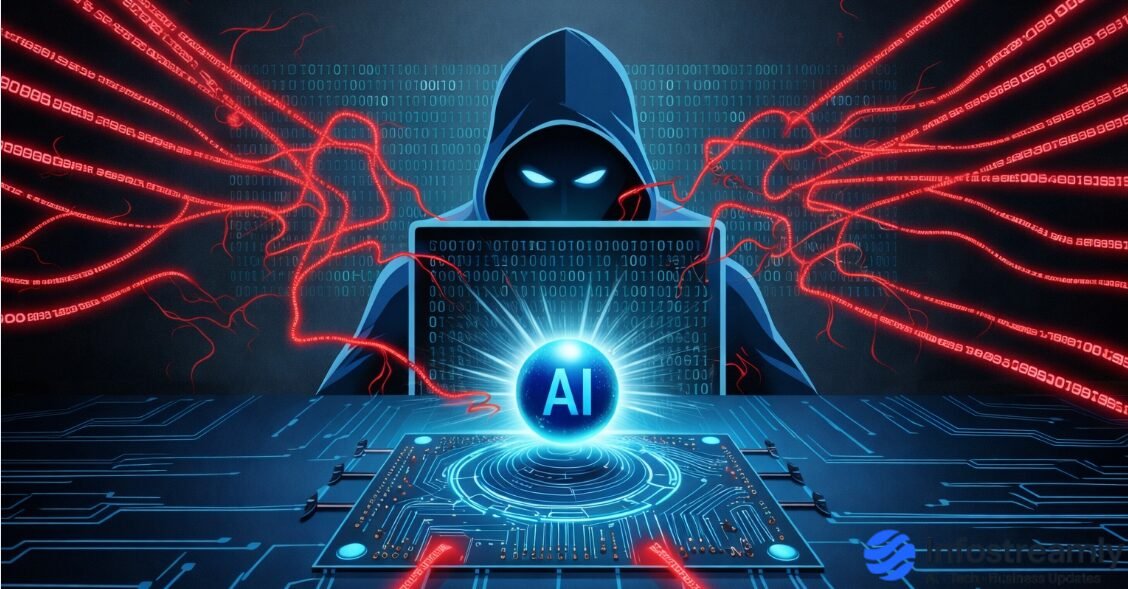
AI cyber attack economy sounds like a heavy, technical phrase, but honestly, it describes a very simple and slightly scary reality we are living in right now.
Introduction
Some people think cyber attacks are still done by super-smart hackers sitting in dark rooms, typing complex code all night.
But the real truth is… that picture is outdated.
Today, a person with basic computer skills, a cheap internet connection, and a small monthly budget can cause serious digital damage. No deep hacking knowledge. No years of practice. Just tools, templates, and AI doing most of the thinking.
This is where things quietly changed. Not loudly. Not with headlines every day. But slowly, like how mobile phones replaced landlines.
Cybercrime also became easier, faster, and cheaper.
And that’s why this topic matters.
More Info: IBM Security
How Cyber Attacks Looked Earlier
Before AI entered this space, hacking was hard.
Honestly, very hard.
Attackers needed:
- Strong programming skills
- Knowledge of networks and systems
- Time to test and fail
- Risk of getting caught early
Because of this, cybercrime had limits. Only skilled people could do it. And those people were not cheap.
A normal attack took weeks or months to plan. Mistakes were common. Success was not guaranteed.
In short, cyber attacks were expensive, slow, and risky.
How AI Changed Everything
Then AI arrived. Not suddenly, but step by step.
First, automation tools.
Then smart scripts.
Then ready-made models.
Now, AI can:
- Write phishing emails that sound human
- Scan systems for weak points
- Generate fake identities and messages
- Adapt attacks based on responses
And the attacker doesn’t need to fully understand how it works.
To be honest, this is where the economics flipped.
More Info: World Economic Forum
AI cyber attack economy Explained Simply
This is not about smarter hackers.
It is about cheaper attacks.
Here’s the simple logic:
- AI tools are sold as subscriptions
- Attack kits are rented like software
- Support is available in underground forums
So instead of paying a skilled hacker thousands, attackers now pay small amounts regularly.
Some tools cost less than a movie ticket per day.
That’s how cybercrime became a low-cost operation.
Why $18 Per Hour Is Enough Today
This number is not magic. It is symbolic.
With around $18 an hour, someone can:
- Subscribe to AI-based phishing tools
- Rent malware generators
- Buy access to leaked databases
- Automate attacks across hundreds of targets
Honestly, that’s shocking when you think about it.
Earlier, such a scale was possible only for organized groups.
Now, even individuals can do it quietly.
No spotlight. No noise. Just results.
Also Read: Cybersecurity income growth in 2026
AI cyber attack economy and Skill Reduction
Here’s an uncomfortable truth.
AI didn’t make attackers smarter.
It made skill less important.
The system now works like this:
- AI suggests the best move
- AI corrects mistakes
- AI learns from failed attempts
The human only clicks and chooses.
Some people think this is exaggeration, but real incidents prove otherwise.
Low-skill attackers are now doing high-impact damage.
Real-World Impact You Can’t Ignore
This shift affects everyone, not just big companies.
Small businesses get targeted because:
- They have weaker security
- They trust emails easily
- They don’t expect attacks
Individuals suffer from:
- Fake job offers
- AI voice scams
- Phishing messages that feel real
Banks, startups, hospitals, schools—nobody is too small anymore.
This is not future talk. This is already happening.
AI cyber attack economy as a Business Model
This part feels strange, but it’s real.
Cybercrime is now organized like a service industry:
- Monthly plans
- Feature updates
- Customer support
- Reviews and ratings
Attackers don’t build tools.
They rent them.
That reduces cost, risk, and learning time.
Honestly, it’s uncomfortable how similar this looks to legal SaaS businesses.
Defensive Side Is Struggling
Security teams are trying, but they are always one step behind.
Why?
- AI attacks evolve faster
- Automated attacks run 24/7
- Detection tools are still rule-based
Human defenders get tired.
AI attackers don’t.
This imbalance is the real danger.
What Needs to Change Now
To be honest, awareness is the first step.
Companies must:
- Train employees regularly
- Stop trusting “normal-looking” emails
- Invest in AI-based defense tools
Individuals should:
- Question urgent messages
- Verify before clicking
- Slow down, even when panic is created
Speed is the attacker’s advantage.
Calm is the defender’s shield.
Conclusion
The world didn’t suddenly become unsafe.
It quietly became easier to attack.
AI didn’t invent cybercrime.
It removed the barriers.
That’s why this shift matters so much.
Final Verdict
The AI cyber attack economy proves one thing very clearly — when technology becomes cheaper and smarter, misuse scales faster than protection.
AI itself is not the villain.
But careless adoption and slow defense are.
If we don’t adapt quickly, low-cost attackers will keep winning small battles every day.
Key Takeaways
- Cyber attacks are no longer skill-heavy
- AI reduced cost and effort dramatically
- Small budgets can cause big damage
- Automation favors attackers right now
- Awareness and patience are critical defenses
FAQs
Is AI responsible for cybercrime growth?
AI is a tool. Misuse happens because humans choose shortcuts.
Can normal people be targeted?
Yes. In fact, individuals are often easier targets.
Are small businesses at higher risk?
Honestly, yes. Limited security makes them attractive.
Is this trend reversible?
Only if defense evolves as fast as offense.

Chandra Mohan Ikkurthi is a tech enthusiast, digital media creator, and founder of InfoStreamly — a platform that simplifies complex topics in technology, business, AI, and innovation. With a passion for sharing knowledge in clear and simple words, he helps readers stay updated with the latest trends shaping our digital world.