Robots in Daily Life no longer feel like a far-away sci-fi idea. There’s no dramatic entry, no sudden takeover moment. Instead, it’s happening quietly—almost invisibly—right inside our everyday routines. If you pause and observe, technology has already blended into how we live: the phones we depend on, the way we make payments, and how we work, shop, and even relax after a long day.
The same will be true for robots. They won’t suddenly show up and change everything overnight. They’ll begin with small, almost unnoticeable tasks—assisting, supporting, and handling repetitive work we barely think about. As people slowly grow comfortable and trust builds, these machines will move into more meaningful roles. The transition will feel natural, not forced.
Between 2025 and 2030, this shift will become much clearer. Robots won’t act like rigid, pre-programmed machines anymore. They’ll start sensing their environment, responding to human behavior, and adapting in real time—closer to how people naturally interact with the world. Companies like Tesla, Figure AI, Boston Dynamics, Google DeepMind, NVIDIA, Amazon, and Hyundai are already developing robots that can understand movement, voice, expressions, and real-world situations.
What’s coming isn’t a loud revolution—it’s a silent evolution. And before most people even realize it, Robots in Daily Life will simply feel… normal.
Also Read: Top 10 Tech Companies Building AGI in 2025
How Robots Will Become Part of Daily Life by 2030
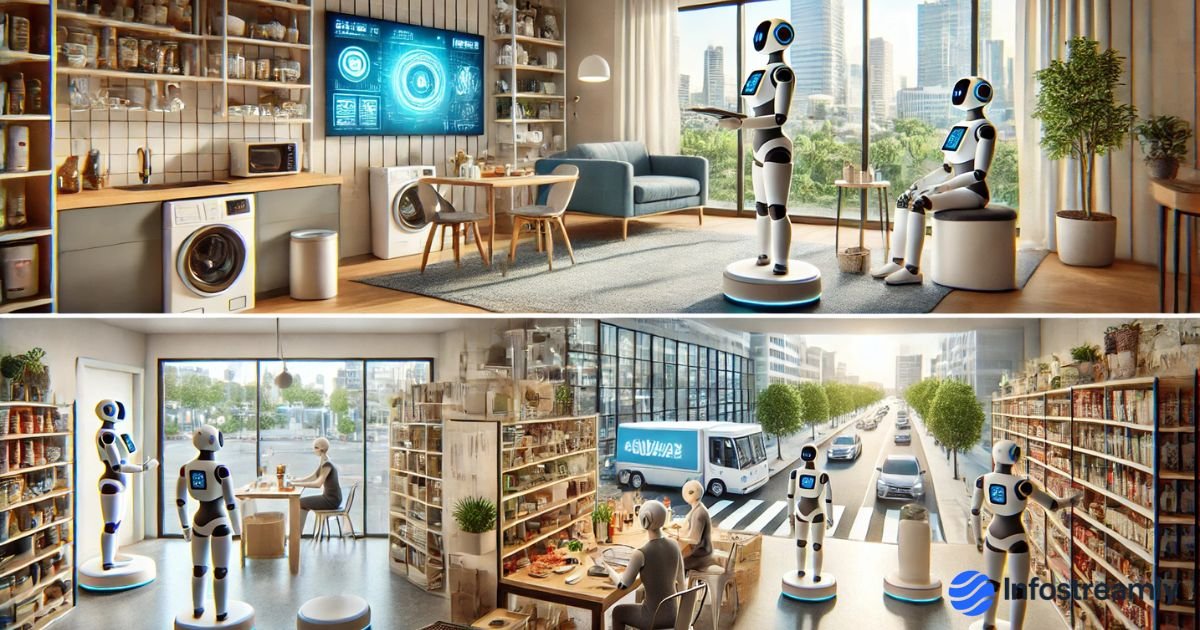
Think about this for a moment. You walk into your house after a tiring day, and instead of staring at a messy room or a pile of dishes, everything already looks… handled. Maybe the robot did a quick clean-up. Maybe it folded the clothes you forgot in the basket. Maybe it even chopped some vegetables and left them ready on the counter.
Funny thing is, this won’t feel shocking by 2030.
It’ll feel convenient — almost expected.
We’re already seeing early versions of this with gadgets like Amazon Astro and Samsung Bot Handy. They’re still early babies in the robotics world, but give them a few more years and they’ll be doing more than just floating around your house with cameras or carrying lightweight objects.
Back then, we used to buy different appliances for different tasks. By 2030, one robot will handle everything: security, cleaning, chores, reminders… almost like a personal helper that never gets tired.
A few things this will change:
- homes will be safer
- elderly people will get constant support
- chores won’t consume half our evenings
- everything will quietly sync with smart home devices
Life will feel lighter.
2. How Robotics Will Transform Elderly Care
If there’s one area where robots will genuinely do good, it’s senior care. Many countries have ageing populations, and there simply aren’t enough caregivers to support everyone. Robots will fill that gap, not as replacements for humans, but as dependable companions.
They’ll remind people to take medicine, stay hydrated, or move around a bit.
They’ll keep an eye on heart rate, sleep quality, mobility, and even detect a fall before anyone else knows.
Some robots will just sit beside someone and talk — letting them share stories, memories, or just pass the time.
Japan and South Korea are already experimenting with these ideas. By 2030, this will exist almost everywhere.
3. Malls, Hotels & Restaurants Will Have Robot Staff
Imagine walking into a mall and asking a robot for directions because it happens to be standing right there. And it actually knows the answer—politely, clearly, and in any language you choose.
That’s where we’re headed.
Robots will handle:
– floor cleaning
– shelf scanning
– answering customer questions
– serving food
– checking stock
Some restaurants in Singapore and Dubai already have robot waiters. They roll around with trays and quietly place your order in front of you. It feels futuristic the first time you see it, but after a few months, you don’t even think twice.
By 2030, this will become so common that people might even forget a time when humans did all of it manually.
4. Delivery Robots & Drones Will Take Over City Streets
If you live in a busy city, get ready—this will be the biggest visible change. You’ll start seeing tiny robots rolling next to you on the pavement carrying groceries or takeout.
You’ll hear drones buzzing overhead delivering medicines or urgent packages.
A van without a driver might pull up to your apartment block and open its compartments so you can collect your delivery.
Companies like Amazon, Zomato, Walmart, Meituan — they’re all pushing for this.
Not because it’s cool, but because delivery becomes faster, cheaper, and more predictable.
Once people get used to it, they’ll wonder how the old system ever worked.
5. Robots Will Step Into Dangerous Jobs
Let’s be honest — some jobs are simply too dangerous for humans.
Mining.
Chemical exposure.
Firefighting in extreme conditions.
Exploring deep ocean spaces.
Walking into disaster zones.
Why risk human lives when a machine can do it?
Boston Dynamics and NASA have been working on robots capable of navigating these extreme environments. By 2030, these machines will be sturdy enough, smart enough, and aware enough to replace humans in hazardous jobs almost completely.
This shift alone could save thousands of lives every year.
6. Schools Will Quietly Add Robots Into Classrooms
Children growing up in the late 2020s and early 2030s will have a very different school experience.
Robots won’t stand at the front of the class teaching lessons—that’s still very human territory.
But they will be around. Helping.
A robot might sit next to a child with learning difficulties and assist them one-on-one.
Another robot may help a science teacher show a 3D model of the solar system or the human heart.
You might see a robot that guides students through simple coding or math exercises—patiently, without ever losing its temper.
Kids will probably treat these robots like friendly gadgets—nothing too strange.
7. Transport Will Slowly Turn Autonomous
Self-driving technology is improving faster than most people realize. A few bumps remain, yes, but the direction is clear.
By 2030, many cities will have
- self-driving taxis
- autonomous buses
- robots managing parking lots
- smart systems monitoring traffic
- driverless delivery vans
When this becomes widespread, commuting will feel less stressful.
And roads might even become safer because machines don’t get distracted, tired, or angry.
8. Emotional Robots Will Support Mental Well-Being
This part may surprise people, but emotional support robots are becoming a thing. Not to replace human feelings—that’s impossible—but to ease loneliness or anxiety, especially for people who live alone or struggle with emotional balance.
These robots will:
- offer calming routines
- talk through stressful moments
- help kids express themselves
- encourage healthy habits
They will be more like a quiet companion than a “machine.”
Conclusion
By the time we reach 2030, robots in daily life won’t feel futuristic.
They’ll feel like the next natural step — just as smartphones once did.
They’ll help us save time, protect us, simplify routines, and support people who need assistance.
The most important part is learning how to work with them rather than worrying about being replaced.
Because the truth is… robots aren’t coming to compete with humans.
They’re coming to help us breathe easier.
Final Verdict
Robots will weave themselves into our world without noise or drama.
At home, at work, in public spaces—they’ll simply be there, handling jobs we don’t enjoy or can’t safely do.
And the people who benefit the most will be those who accept this shift early and learn how to use these tools wisely.
Key Takeaways
Robots will become everyday helpers across homes and workplaces.
Humanoids like Tesla Optimus will handle multi-purpose tasks.
Senior citizens will get reliable support.
Delivery automation will save time and money.
Emotional robots will help with stress and loneliness.
New robot-related jobs will grow fast.
FAQs
1. What does “robots in daily life” actually mean?
It simply means robots doing everyday tasks—cooking, cleaning, delivering things, helping students, and supporting elders. Nothing dramatic, just quiet help.
2. Will robots replace human jobs?
Not fully. They’ll take repetitive tasks, but new jobs in robotics, AI training, and maintenance will grow even faster.
3. What robots will become common by 2030?
Cleaning robots, humanoids, delivery bots, self-driving vehicles, teaching robots, healthcare assistants, and emotional companion robots for kids and seniors.
4. Are home robots safe?
Yes. Modern robots come with sensors, cameras, emergency shut-off systems, and tons of safety layers.
5. How will robots help senior citizens?
They’ll remind them to take medicine, help them walk around, detect emergencies, talk to them when they feel lonely, and keep track of their health.
6. Will delivery drones take over?
Most likely, yes. They’ll deliver essentials faster than traditional delivery workers.
7. How should people prepare for a robot-powered future?
Learn basic AI tools, get comfortable with automation, and be open to using new technologies. That’s all.

Chandra Mohan Ikkurthi is a tech enthusiast, digital media creator, and founder of InfoStreamly — a platform that simplifies complex topics in technology, business, AI, and innovation. With a passion for sharing knowledge in clear and simple words, he helps readers stay updated with the latest trends shaping our digital world.