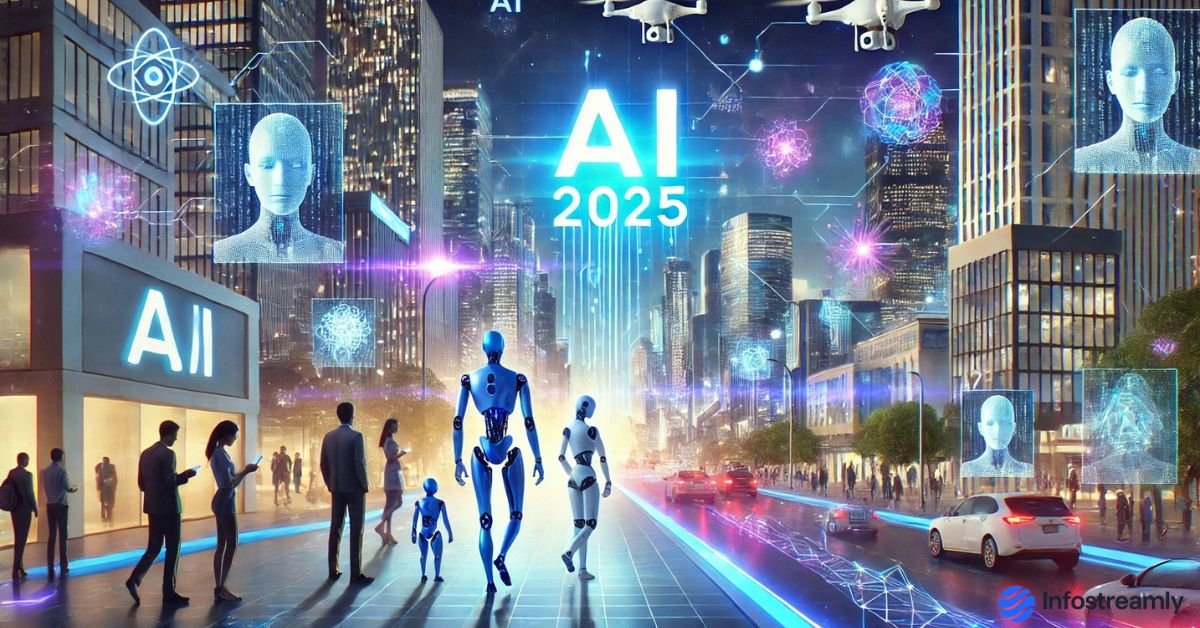
AI Trends 2025 are shaping a future that feels both exciting and a little surreal.
We’re surrounded by artificial intelligence every single day—yet most of us don’t even realize it.
It’s there when your phone predicts what you’ll type next, or when Netflix somehow picks the movie you were already in the mood to watch.
But 2025… well, it’s hitting differently.
AI isn’t just another piece of tech talk anymore—it’s starting to feel like that smart friend who quietly helps you out, keeps track of your habits, and sometimes even surprises you with how much it knows.
Crazy, right? Everything’s changing so fast that it’s hard to keep up.
So, let’s dive into the AI trends of 2025 that are already reshaping how we work, live, and create every single day.
1. Rise of AI Agents
You’ll be hearing this word everywhere—AI Agents.
Think of them as digital employees who can think, plan, and act on their own.
Unlike old chatbots that just answer questions, AI agents can complete full tasks.
They can write a blog post, reply to emails, schedule your day, or even build software—all by themselves.
In 2025, tools like OpenAI’s GPT-based Agents, Anthropic’s Claude 3, and Google Gemini 2 are showing what’s possible.
Businesses are already testing these agents for customer support, data research, and marketing automation.
👉 Learn more about AI Tools for Google Gemini vs ChatGPT (2025) – Complete Comparison of Features & Accuracy
Why it matters:
AI agents will save time, cut costs, and boost productivity—almost like having an extra team that never sleeps.
2. Multimodal AI Becomes Mainstream
Here’s something cool—AI that can see, hear, and talk all at once.
That’s called multimodal AI, and it’s the biggest creative shift of 2025.
Imagine showing a product photo to AI and saying, “Write a YouTube ad script for this.”
Or uploading a 5-minute video and asking, “Give me the summary and best moments.”
That’s exactly what tools like GPT-5, Gemini Advanced, and Claude Opus can do now.
They understand text, images, voice, and video together—just like humans do.
👉Read about Google DeepMind’s Multimodal Research to see how it’s shaping the future.
3. Generative AI Goes Professional
In 2023–2024, AI was mostly for fun—writing stories, generating art, or creating memes.
But now in 2025, generative AI has gone professional.
Designers, filmmakers, educators, and even architects are using AI tools like Runway, Pika Labs, and Sora by OpenAI to create high-quality videos and 3D visuals in minutes.
Students are using AI tutors for personalized learning.
Teachers are preparing lessons with AI-generated visuals.
It’s creativity on demand—fast, smart, and inspiring.
AI is becoming a medical assistant that can predict diseases before they happen.
It studies data from your wearables, DNA, and health apps to catch problems early.
For example, AI can now estimate your heart risk, detect cancer relapse, or track sleep disorders.
Startups are building predictive models that save lives through preventive care.
So instead of reacting after you get sick, AI will soon help you stay healthy in the first place.
That’s not just smart—it’s life-changing.
👉 See how AI is transforming healthcare at NVIDIA.
5. Ethical and Responsible AI Takes Center Stage
Let’s be honest—AI is powerful, but it can also be risky if misused.
That’s why AI ethics is becoming a huge focus in 2025.
Countries are introducing new laws like the EU AI Act and the US AI Bill of Rights, and India is drafting its own policy for safe AI.
Companies are now working on:
- Bias-free data
- Transparent algorithms
- Human oversight in AI systems
Trust will become the new currency in the AI industry.
People will only use technology they can trust.
AI-Driven Automation and Job Transformation
Here’s the truth: AI will not take away all jobs.
But it will change how we work.
AI copilots are already helping professionals write emails, analyze data, and even code software.
By 2025, every major company will use AI to automate boring tasks.
New roles will appear—like
- Prompt Engineers
- AI Quality Analysts
- Workflow Designers
So instead of replacing us, AI will become our teammate.
It’s not “man vs. machine” anymore—it’s “man + machine.”
7. AI + Blockchain = Verified Truth
AI creates tons of content—but how do you know what’s real?
That’s where Blockchain comes in.
In 2025, combining AI with blockchain will make data traceable and trustworthy.
Every image, video, or article generated by AI could have a digital signature, showing when and how it was made.
This means no more deepfake confusion or fake news from AI.
You’ll be able to verify the truth instantly.
👉 Learn more about Blockchain for AI Data Security.
8. Edge AI – Smart Devices, Zero Lag
Not everything needs the cloud anymore.
Edge AI is bringing intelligence right into your pocket.
In simple words, your phone or smartwatch can now run small AI models directly—no internet required.
Companies like Apple, Qualcomm, and Nvidia are building these tiny yet powerful AI chips.
You’ll soon see real-time translation, camera intelligence, and smart assistants that work offline.
It’s faster, safer, and much more private.
9. AI Safety and Global Regulations
AI safety isn’t just a tech topic—it’s a world issue.
In 2025, governments and companies are joining hands to make AI more accountable.
Big players like OpenAI, DeepMind, and Anthropic are focusing on AI alignment—ensuring that machines understand human goals and don’t go off track.
AI will now be tested, monitored, and certified for use in sensitive sectors like finance, defense, and healthcare.
This is a crucial step toward building trustworthy AI that helps, not harms, humanity.
10. Personalized AI for Everyone
Imagine having your own personal AI companion—trained just for you.
By the end of 2025, that dream will come true.
You’ll have:
- A personal writer AI that knows your tone.
- A fitness AI that tracks your daily goals.
- A money planner AI that manages your spending.
Each person will have a unique AI ecosystem—private, personal, and perfectly tuned to their lifestyle.
It’s like having your own assistant, teacher, and life coach—all rolled into one.
Conclusion
The real story of 2025 isn’t about AI taking over.
It’s about how humans and AI are growing together.
AI is no longer just a tool—it’s your teammate, your idea partner, and your digital friend.
Those who learn to use it smartly will move ahead faster.
So don’t fear it.
Learn it.
Work with it.
Because in 2025, the future belongs to people who understand AI, not those who ignore it.
Final Verdict – The Human Side of AI
When we look at all these AI trends 2025, one thing becomes clear — this isn’t just about machines getting smarter.
It’s about how we adapt, learn, and grow with them.
AI is learning fast, yes, but humans are learning faster — learning how to use it, control it, and make it work for us.
Instead of fearing what’s coming, this is the time to embrace it.
Because the future of technology isn’t cold or robotic — it’s deeply human, powered by creativity, curiosity, and imagination.
And that’s exactly what makes this next phase of AI so exciting.
Key Takeaways — What You Should Remember About AI Trends 2025
- AI is everywhere: From your phone to your car, artificial intelligence has quietly become part of daily life.
- AI Agents are coming: 2025 will be the year of autonomous AI workers — digital assistants that can plan, act, and learn by themselves.
- Creativity meets AI: Tools like Sora, Runway, and Midjourney 6 are turning text and imagination into videos, art, and stories in minutes.
- Healthcare gets smarter: Predictive AI will spot diseases earlier and personalize treatments like never before.
- Responsible AI matters: Governments and tech giants are enforcing transparency, fairness, and human oversight in AI systems.
- Jobs are evolving, not vanishing: New roles like Prompt Engineer and AI Workflow Designer are on the rise.
- Personal AI companions: Everyone will soon have AI assistants tailored to their habits, goals, and lifestyle.
In short — AI isn’t taking over; it’s teaming up with us.
Those who understand it early will shape the future.
AI isn’t a far-off dream anymore — it’s happening now.
So, whether you’re a student, creator, or business owner, start learning how to use AI tools today.
And don’t forget to bookmark InfoStreamly for weekly posts on tech, AI, and innovation that actually make sense — in simple, real-world language.
FAQs
- 1. What is the most important AI trend in 2025?
The rise of AI agents—autonomous systems that can think and act without constant human help. - Will AI replace jobs in 2025?
Not fully. It will take over repetitive tasks but create new creative and technical roles. - Which companies lead AI innovation?
OpenAI, Google DeepMind, Microsoft, Anthropic, and NVIDIA are currently the top players. - What is multimodal AI?
It’s an AI that can understand text, images, audio, and video at once—like how humans perceive the world. - Is AI regulation coming soon?
Yes. The EU AI Act and similar laws in India and the US are setting global rules for safe and ethical AI use.

Chandra Mohan Ikkurthi is a tech enthusiast, digital media creator, and founder of InfoStreamly — a platform that simplifies complex topics in technology, business, AI, and innovation. With a passion for sharing knowledge in clear and simple words, he helps readers stay updated with the latest trends shaping our digital world.